
This is it! The Raiders of the Lost Ark session we’ve all been waiting for. Don’t forget your whip. But leave that traitor Satipo behind.
At last, a death trap dungeon. Now your playing my jam!
When last we left our heroes, they had been striving valiantly to deliver their ally, Undril Silvertusk, to Camp Righteous, a faction outpost for the Order of the Gauntlet. Along the way they have been captured by Yuan-ti, kidnapped by goblins, and beset by all manner of beasts, plants, monsters, spectral mists, and even frost giants. At long last, our heroes have arrived at Camp Righteous… Only to find it ransacked and abandoned.
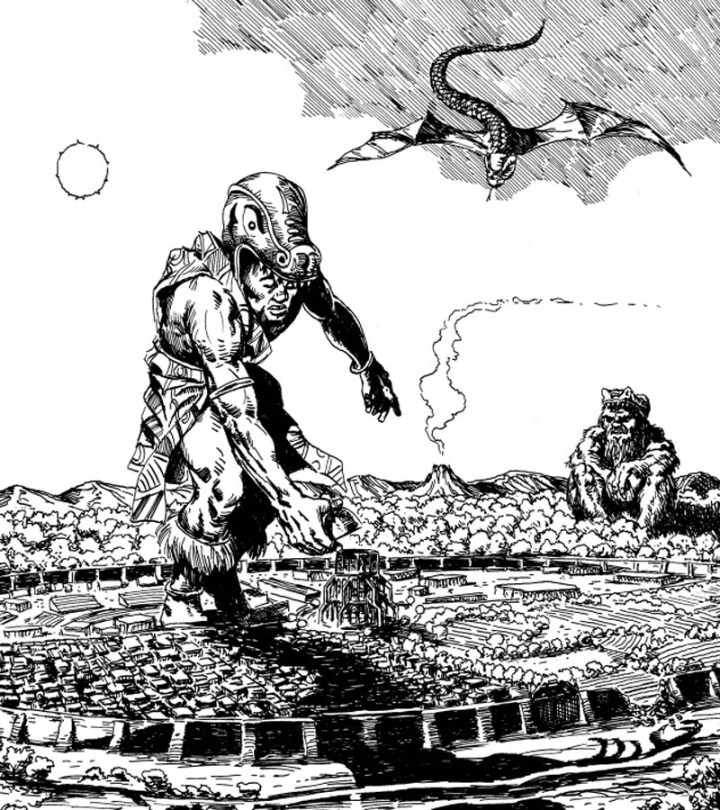
They have clue as to where the Order went, but right now their focus is on the enormous structure in the center of the Camp. The camp was built on the shore of a local landmark, a gigantic 80’ statue carved out of a large hill. Their tabaxi guide, Flask of Wine, explains that this monument is called “The Crocodile Man” and retells the fable of a crocodile that tricked Man into carrying the beast all over the world, thus making them enemies evermore.

I love this kind of world building and lore, and I wish that there was more of it in the book. I’ve been trying to create a similar fable that incorporates the trickster gods, but I haven’t come up with anything I like. I’ll keep trying. For now, we’ll just have to get the most use out of The Crocodile Man. A doorway at the base of the statue beckons the brave and the foolish to explore its mysteries.
The Crocodile Man is a trap-filled extravaganza with zero combat encounters, so it has several unique challenges. First, you have to describe each room in a way that doesn’t give the trap away but doesn’t feel like a dirty trick once it is sprung. Saying, “There is nothing unusual about this section of hallway, nothing unusual at all, hee-hee,” is just as unsatisfying as “Ha-hah! You didn’t state that you were looking for traps this one time so here is where trap is. You fall into a bottomless pit and die. I win!”
Second, you have to understand exactly how each trap works. How is it triggered? By weight, tripwire, sensor, touch, or other means? How does it cause damage? Gravity, weaponry, poison, spell, or some combination of effects? And finally, how can it be caused to fail or circumvented? These possibilities too numerous to list and are only limited by your players boundless imabination. And I guarantee that the solutions you predetermine to work will not be the ones your players think of, so get ready to improvise.

Chances are high that one player will have learned the spell Find Traps. That’s totally fine. It’s really no different than the thief constantly checking for traps or the player probing every floorboard with the ubiquitous 10’ pole. It’s okay if they find the trap; they still don’t know exactly how to avoid it.
Worse however, is the Dungeon Delver feat. It basically nullifies all traps for that player. I don’t mind the advantages given to find and avoid traps, but the resistance to all trap damage on top of that is just too much. I would carefully judge the nature of each trap when deciding if that resistance applies and when determining damage.
If a ceiling collapses or he falls into a simple pit, fine, his skill allows him to dodge or land on his feet, so take half damage. But are there spikes at the bottom of the pit that he can’t see? He probably won’t dodge those. What about a poison needle trap? Sure, he takes half damage from the needle but full damage from the poison. But if he’s caught in an area effect trap, like a fireball, or fails to safely overcome some obstacle, then no, beyond whatever saving throw that might provide half damage, he does not get automatic damage resistance on top of that. This guy I know, Seth Skorkowsky, has an excellent video on the nature of traps, puzzles, and obstacles. You should check it out.

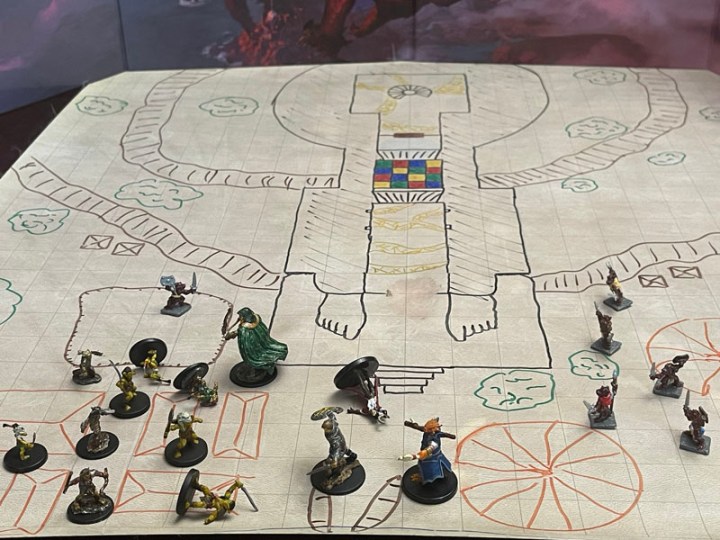
Fortunately for me, none of my players have any of these abilities, so they get to discover these traps the old-fashioned way. By falling into them. Simple traps like pits don’t need to be illustrated, but some of the traps in the Crocodile Man are more like puzzles, so I drew up a battle map for the dungeon to help my players visualize the area. I had wanted to build a full-scale model of the rising platforms to better reflect the different levels of the dungeon, but I didn’t have time. My players will just have to suffer through my 2-D version instead.

At the entrance, there are steps that lead up to the base of the statue. I tell my players that these steps rise 3’ up from the jungle floor. This trivial detail is not in the book, but I added it because it will give a clue to the last trap in the shrine. Next, each trap is set in its own 10’ by 10’ room that ends at a 7’ wall that the players have to climb over to get into the next trap room. The book repeatedly describes that each ceiling is 23’ high. I cannot find any significance to this number, so I changed the ceiling height to 24’ high to also play into that last trap, as we will soon see.
Even without any foreknowledge, your players will probably guess that this is a trap-filled dungeon. My players asked me directly if this was so. I didn’t confirm this directly, but I did add another detail that further strengthened their suspicions and if nothing else, put them on guard. “Standing in the doorway, the air is deathly still and no sound issues forth from the gaping maw of the shrine.” Now convinced that nothing good lay ahead, Gwen casts light, aid, and guidance on Martic since he is the stealthy one and he will be running point from here on out. But before they can enter the shrine, they have to hack their way through the veritable wall of spider webs that fill the entire hall.

Of course, the “giant” spiderwebs that drape through these halls convinced the players that the are about to be attacked by giant spiders. But these webs are just here to remind players of that first scene in Raiders of the Lost Ark, where Indiana Jones delves into the Temple of the Warriors, which is the canonical name for the shrine Indy discovers at the start of the movie. To further drive this point home, I had a cluster of tarantulas (also the real term for a group of spiders) land on the player character’s heads. Imitation is the sincerely form of flattery. And plagiarism.
Before we go on, just a quick note about the intended means to bypass all these traps. WARNING! – Players, do not read this next sentence. If one player rides on the shoulders of another player (just like the Crocodile Man) then none of the traps will trigger. This is a neat and sensical solution based upon the story of the Crocodile man, but it is completely non-sensical from a trap perspective. I like my traps to have a certain logic to them and this has none. How does the shrine know if the trigger condition is met or not? Weight distribution? Invisible sensors? Magic? If any of these are true, then there would be other ways to disable the traps. My explanation is because I’ve already had numerous instances of inexplicable divine stuff happening in Chult, then this shrine and all her traps operate based upon some divine (and thus unbreakable) divine power.
The first trap is a simple pit trap, but since, naturally, no one deduced the as-written trap solution, and Martic, despite his advantages, failed his checks, and, luck was against him because the trap activates only half of the time, Martic triggered the trap. But my players were smart. They had tied a rope around Martic, to pull him out of danger if need be. I allowed that Martic only fell 10 feet before the rope went taut, slamming him into the pit wall and taking only 1d6 damage, instead of the full 2d6. So, kind of like the dungeon delver feat, but earned through player ingenuity, not an over-powered stat sheet.
So now the pit trap has become an obstacle. How do they get across? They refused to have anything to do with the ledges that would have allowed players to shimmy along the wall past the pit. They were convinced it was a trick, and would somehow dump them into the pit. After a loooong discussion involving many discarded options: going into full mountain climbing mode using ropes, pulleys and pitons, building two 20’ ladders, spider climb, misty step, and shooting arrows tied to ropes and making a zipline, they chose an elegant, lazy solution. They went back to the beach, grabbed a canoe and placed it over the pit to make a pretty precarious bridge.

Despite their best efforts and me making the DC to walk across this wobbly boat bridge and easy 5, Gwen still failed to cross and fell into the pit. Twice. First, she fell off the bridge, then she fell again when she tried to climb out of it. She took a staggering (for her) 14 points of damage. Maybe she should she this one out. But she soldiered on. To reward her perseverance, I threw some random treasure scattered around the dozens of dead bodies that I added to the bottom of the pit. Our heroes are not the first to explore the mysteries of the Crocodile Man. We’ll see if they are the first to succeed.
The next trap room is the spinning blades from Indiana Jones and the Last Crusade. I’m detecting a theme here. This one is also only triggered half of the time. Martic found and identified the trap and he thought he found the correct path through. Despite not solving the trap the “correct” way, he walked through unscathed. Roland followed in his footsteps and also made it to the other side unharmed. Thames, thinking this was too easy, went next and got sliced and diced for 18 points of damage. I love the fact the two hearty, high hit point, front men have taken barely any damage, and the two squishy wimps in the back are getting clobbered. While they struggled to figure out the trick to these traps, they at least jammed all the blades with pitons to defeat this one.

The next trap is where they accidentally uncovered the secret to the shrine. You don’t need to draw out the entire dungeon like I did, but you should at least draw out this room. It is impossible to convey the nature of this trap without a visual aid. Also, I did add color to the tiled floor, to illustrate a distinction between the tiles. In addition to the pattern on the floor, I drew the pattern on the door on the ledge above them on an index card and then folded it so that the players could only see the top two lines of the door pattern from their current position. This allowed me to sit back, and let the players work out for themselves the solution without me accidentally giving it away by talking too much.
Eventually, they realized that the tiles on the door matched the tiles at the far end of the room they were in, but they couldn’t see any tiles matching the one nearest them. Wes came up with idea that they maybe could see the rest of the door if they were taller and suggested that they might see it if Roland were to get on Martic’s shoulders. This worked, and now Roland could see the entire door and all the matching tiles and especially the one tile that was lit up showing them where to step next. This was the best moment in the session for me, as I got to watch the dawning realization come across my player’s faces. Finally, one of them said what everyone was thinking, “Of course, The Crocodile Man. We should have been on each other’s shoulders the whole time.” I was very proud.

It’s actually pretty rare to have a puzzle trap play out in such a satisfying way. Usually, either one player solves it right away, often before any of the other players can even begin to work out a solution, or everyone is stumped forever, until you take pity on them and spoon feed them clues until you practically give the whole secret away. On top of that, there’s often a feeling of, “Well, that was stupid. How where we supposed to figure that out?” But this time, it played out about as well as it could go. Some heroes took some damage, no one died needlessly, they figured the puzzle out on their own, and they were satisfied that the solution made sense. Perfect.
From here on out, Roland sat on Martic’s shoulders, while Gwen sat on Thames, which Thames was not pleased about. They made their way through the randomly assigned tiles, which in my game was red, red, yellow, red. To make the step from Row 1 to Row 2 (the only step with a gap between the tiles) I made them roll an extra Athletics check, just to give them a little more fear, but they passed. They scrambled up the ledge as a unit. At the door, they correctly concluded that each member of the piggyback team had to press two of the door tiles, two for the lower and two for the upper. But the book states that they must be pressed in sequence from bottom to top. My players guessed that they needed to be pressed at the same time, since there were four tiles and between the two of them, they had four hands. This seemed an even better solution than the book’s, so I allowed it to be the correct one.
In the final room, there is a spiral staircase with 30 steps rising up to a platform at the top. The book states that there are explosive runes on steps 3, 10, 17, and 23. There is no clue or indication that this exists and the numbers don’t follow any discernable pattern, making this an underhanded, sneaky, and mean trap. That’s why I mentioned that my players first walked up three steps into the shrine. Then if you add seven feet for each wall they had to climb up, that gives you the numbers 3, 10, 17, and 24. That’s where I placed my glyphs. I am a firm believer that traps and puzzles should have a logic to them and an obtainable solution.
For my group this was moot, because Martic and Roland walked up the steps in piggyback fashion, disabling the traps and avoiding any explosions. For now. At the center of the upper platform was a small pedestal. On the pedestal, there was a mysterious urn of some kind. This is an alchemy jug, which is frankly a rather uninspiring (and only) treasure at the end of this death trap dungeon. Don’t get me wrong, an alchemy jug is useful and will basically solve any dehydration issues for the rest of the adventure. But c’mon, where’s the golden idol of immeasurable wealth that men would kill for?

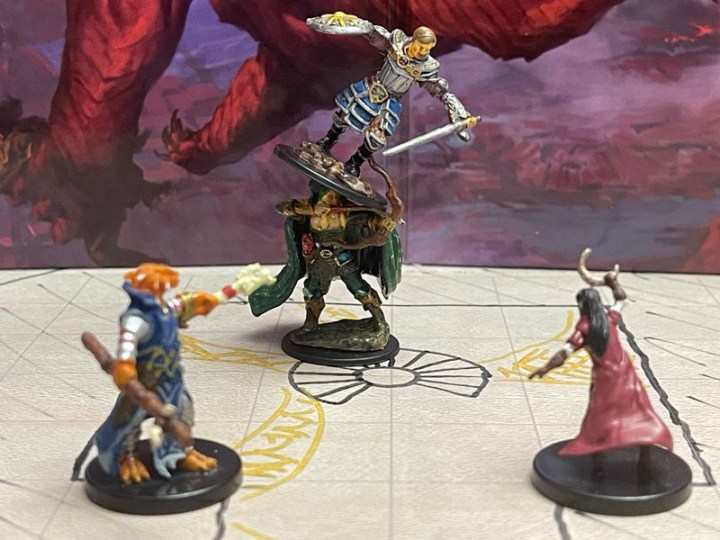
My players took the jug off the pedestal and they did it while still riding on the other’s shoulders, so they should have walked away clean and exited the dungeon. But where’s the fun in that? Stealing just one more item from Indiana Jones, my players did not replace the jug with a bag of sand of equal weight. When they took the jug, the pedestal sank into the ground and they knew they were screwed. The shrine began collapsing around them, brick and masonry began to fall from the ceiling. In their precarious Crocodlie Man position on a narrow ledge being pelted with plaster, both Martic and Roland fell off the pedestal. Thames cast feather fall, saving the two from going splat on the hard stone floor.
But the ceiling was still collapsing. Bits of rock were landing on the glyphs, setting off bolts of lightning that blasted even more of the temple apart. It was every man and crocodile for himself as all four ran out of the shrine; out the mosaic door, past the tiled floor as jets of flame singed their backsides because they paid no heed to what tiles they were stepping on, down past the blocked blades, and over the canoe bridge which collapsed into the pit just as the last player scrambled across. They burst out into the fresh air as dust and debris sealed off the entrance. The statue exterior remained intact, but the interior was now buried in rubble.

Of course, there is one more moment from Raiders that we do get. Just as out heroes emerge from the Crocodile Man, there is a group of native Batiri goblins waiting to take their treasure away. They are led by a goblin boss named Yokka. I renamed this guy to Belloq for obvious reasons. Yokka-Belloq pontificates obnoxiously about outsiders plundering the Chultan heritage, that the land rightfully belongs to the native inhabitants, and that our heroes with their colonial imperialism makes them the true bad guys here. Then the goblins attack, taking full use of the cover provided by the ruined huts while the players stand out in the open like donkeys. The battle is made even more chaotic when a flock of axebeaks arrives to free their friend from the caged pen.
Ultimately, our heroes exert their dominance and their self-proclaimed right to imminent domain by exterminating a technologically inferior indigenous species. Those uppity savage goblins are massacred and the docile witless axebeaks are liberated from one cage and into another on the players’ canoes to be dragged thousands of miles from their home only to be gawked at and experimented on by their Euro-centric overlords. “Wait, are we the bad guys here?”
After the battle, the gaggle of NPCs including Silvertusk, Miche, River Mist, Flask of Wine, and all the various porters show up out of the blue with some lame excuse about being chased of into the jungle by baboons or whatever. I gotta be honest, all these NPCs serve a story and logistical reason to exist, but it’s getting frustrating to keep creating new ways to keep them out of combat and keep the players from abusing these NPC meat shields. But all is forgiven because we have the world’s best physical prop to cap off our Indiana Jones Session Spectacular.
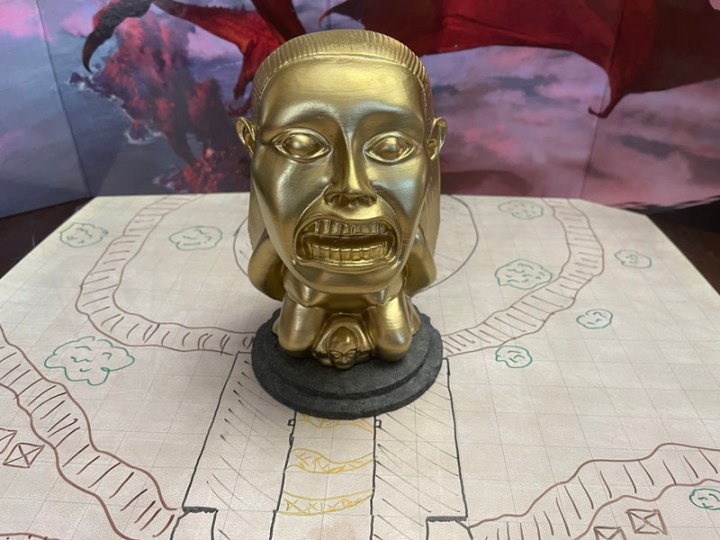
Next week, certain amphibians seek revenge, we complete our first quest, and the death curse finally begins. Yea, death!
As always, filling your stories with pop-culture references and nostalgia-bait is the easy, lazy way to elicit enthusiasm, and Game On!
Again, we see there is nothing you can possess which I cannot take away – Belloq. I’m really trying to get this guy into the campaign, but I haven’t found the right moment.

Don’t forget to check out my Tomb of Annihilation Resources Page, filled with all the stuff I use to make this epic campaign even more epicier: My full Campaign Diary, plus Handouts, Maps, Charts, PDFs, Images, and more to use, abuse, or ignore at your peril.
And written specifically for this adventure, read my Explorer’s Guide to Chult to delve into all the legands, lore, history, religion, and culture that I used to bring even more life to this adventure.

 Game Night Blog
3 thoughts on “D&D Diary – Tomb of Annihilation – Session 17”